 BICGA wheat portal
Florence Auroreorigin:Tunisia first record:1922 habit:Spring grain colour:white yellow references >>> |
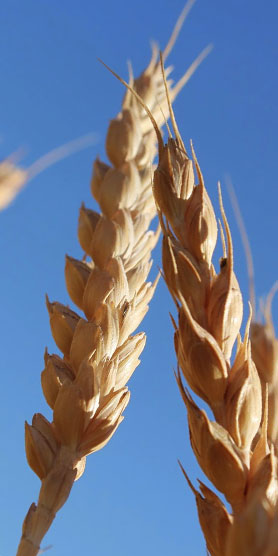
Florence Aurore
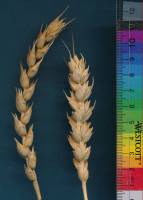
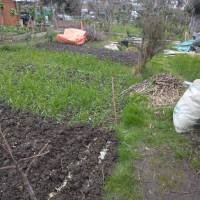
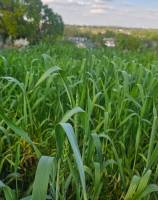
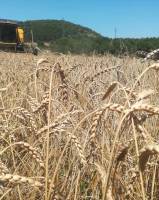
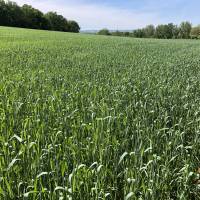
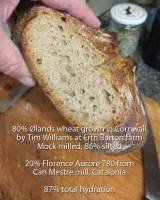
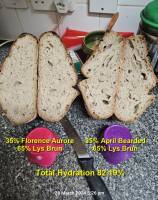
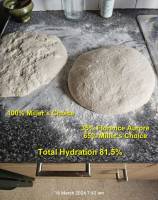
Florence Aurore is a late heritage wheat created by hybridisation between two Australian wheats in France and further developed in Tunisia going on to be grown across North Africa and the Levant and then into Spain and France. It was prized as a "blending wheat" which would increase dramatically functionality, even when just a small proportion, in a blend with softer heritage wheats and can still be used in this fashion.
Reference #1
Le Blé meunier d’Apt by Elise Bain, 2007 LINKnotes: translation of section referring to Florence Aurore, page 70
"Florence Aurore
Florence Aurore is one of the wheat varieties that had the greatest impact on farmers of that era; in fact, it's the one I heard most often mentioned by my interlocutors after Miller's Wheat. "Florence Aurore is an INRA variety dating back to 1936," one of them, whose extensive knowledge of wheat is particularly rich, told me. In reality, depending on the region, the locality, or even the countryside, farmers say they discovered it before or after the Second World War.
It was sown throughout the geographical area where Miller's Wheat of Apt was traditionally cultivated. Its presence was also confirmed to me in the Forcalquier region, near Manosque, and it was found in Comps-sur-Artuby in the Champsaur and Dévoluy valleys, the Oisans, the Valbonnais, the Beaumont, and in the Upper Ubaye Valley.
It seems to have been one of the longest-cultivated varieties, as several people suggested to me that it was among the last soft wheats to be used in the region.
In agricultural terms, "Florence Aurore was a three-month wheat sown in the spring; it was called 'Three-Month Wheat'." It was known for its minimal tillering, and I was even told that "it needed to be sown a bit thicker, 200 kilos per hectare instead of 180 for milling wheat." According to those interviewed, it was considered a "semi-durum" wheat, "not quite durum wheat, but better than soft wheat," a "strong wheat," an "improving wheat," or even a wheat "more than suitable for breadmaking." It is said that it "weighed 87 in specific weight" – whereas milling wheat only weighed 65 – which is much more than normal. "It was one of the best wheats," I am regularly told. "When it arrived, it somewhat supplanted all the other varieties; because the straw was a little shorter, it was a little less prone to lodging, and for breadmaking, it produced a very elastic dough, which was highly sought after," I was told in the Aigues region. "It was a very good wheat, more of a semolina wheat, but I used a little to give some of what we call strength to the flours," recalls Mr. Bremond, former miller at the Pangon Mill in Limans. "It was mainly used for cakes; sometimes we added 20 to 30% of it to flours intended for breadmaking to strengthen the dough." Finally, my contact from Grambois told me that: “Florence Aurore was highly valued during the war; the small mills we had there provided us with flour and hulled wheat. We made soup and even dishes considered on par with rice. We cooked the wheat with broth and a piece of pork; it was delicious!”
Its quality made it one of the most renowned varieties in the region, which, in some years, even sold for more than other soft wheats."
Reference #2
Development and spread of high-yielding varieties of wheat and rice in the less developed nations by Dana G. Dalrymple, 1978 LINKnotes: CIMMYT account of the history of Florence Aurore
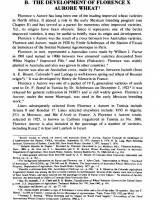
"THE DEVELOPMENT OF FLORENCE X AURORE WHEAT
Florence x Aurore has long been one of the leading improved wheat varieties in North Africa. It played a role in the early Mexican breeding program and has served as a parent for numerous other improved varieties. Yet, its origins have been obscure. Since it represents one of the better improved varieties, it may be useful to briefly trace its origin and development.
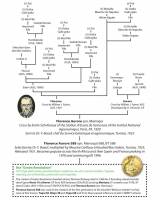
Florence x Aurore was the result of a cross between two Australian varieties, Florence and Aurore, made in 1920 by Emile Schribeaux of the Station d'Essais de Semences of the Institut National Agronomique in Paris.
Florence, in tum, represented a Australian cross made by William J. Farrar in 1901 and named in 1906 between two unnamed varieties descended from White Naples, Improved Fife, and Eden Fulcaster. Florence was widely planted in Australia and also was grown in other countries.
Aurore was also an Australian cross, made by Farrar, between Jacinth from A. E. Blount, Colorado and Ladoga a well-known spring red wheat of Russian origin. It was developed by Henry de Vilmorin in France.
Florence x Aurore was one of a packet of 19 F2 generation varieties of seeds sent to Dr. F. Boeuf in Tunisia by Dr. Schribeaux on December 2, 1922 It was released for general cultivation in 1930/31 and is still widely grown. Florence x Aurore, under the name Marroqui, was used in the early Mexican breeding work.
Lines subsequently selected from Florence x Aurore in Tunisia include Ariana 8 and Koudiat 17. Lines selected elsewhere include: 8193 in Algeria, 2511 in Morocco, and Ble d' Avril in France. A Florence x Aurore strain, selected in 1925, is known as Cailloux (registered in Tunisia as No. 588). Florence Aurore is also included in the parentage of a number of varieties, including Karaj 2 in Iran and Lakhish in Israel."
Germplasm link
Ble Cailloux INRA (FRA) #7967
Cailloux #TA02547
Cailloux USDA-ARS (USA) #PI 191446
Cailloux ITA266 (ITA) #SALT8800382
Cailloux VIR (RUS) #k44480
Cailloux USDA-ARS (USA) #PI 304915
Cailloux AWCC (AUS) #85
Cailloux INIA-CRF (ESP) #BGE012175 / NC027952
Cailloux PGRC (CAN) #CN 9711
Cailloux USDA-ARS (USA) #PI 152441
Cailloux RCA (HUN) #RCAT000182
Cailloux INIA-CRF (ESP) #BGE011876 / NC027609
Cailloux IBBR-CNR (ITA) #MGD0008417
Cailloux USDA-ARS (USA) #PI 283844
Cailloux AWCC (AUS) #84
Cailloux CIMMYT (MEX) #CWI 10478//GID 263146
Cailloux AWCC (AUS) #10836
Cailloux IPK (DEU) #TRI 8446
Cailloux B.J. AWCC (AUS) #2039
Florence Aurore INIA-CRF (ESP) #BGE043865 / NC094981
Florence Aurore USDA-ARS (USA) #PI 329233
Florence Aurore AWCC (AUS) #13206
Florence Aurore INIA-CRF (ESP) #BGE000002 / NC003545
Florence Aurore USDA-ARS (USA) #PI 378922
Florence Aurore AWCC (AUS) #14267
Florence Aurore CGN (NLD) #CGN12519
Florence Aurore #TA03081
Florence Aurore USDA-ARS (USA) #PI 150609
Florence Aurore ITA266 (ITA) #SALT8800973
Florence Aurore USDA-ARS (USA) #PI 342641
Florence Aurore AWCC (AUS) #13207
Florence Aurore IPK (DEU) #TRI 8162
Florence Aurore USDA-ARS (USA) #PI 150111
Florence Aurore CIMMYT (MEX) #CWI 32704//GID 1992
Florence Aurore USDA-ARS (USA) #PI 150608
Florence Aurore IPK (DEU) #TRI 25585
Florence Aurore 2511 RCA (HUN) #RCAT002892
Florence Aurore 2511 INIA-CRF (ESP) #BGE002845 / NC011719
Florence Aurore 3193 USDA-ARS (USA) #PI 263417
Florence Aurore 588 INIA-CRF (ESP) #BGE002844 / NC011718
Florence Aurore 588 CIMMYT (MEX) #CWI 91946//GID 5895555
Florence Aurore 588 USDA-ARS (USA) #PI 278656
Florence Aurore 588 INIA-CRF (ESP) #BGE010013 / NC006522
Florence Aurore 588 USDA-ARS (USA) #PI 174634
Florence Aurore 8189 CIMMYT (MEX) #CWI 7782//GID 5895564
Florence Aurore 8191 INRA (FRA) #9059
Florence Aurore 8192 USDA-ARS (USA) #PI 168793
Florence Aurore 8192 CIMMYT (MEX) #CWI 6345//GID 5895566
Florence Aurore 8193 CIMMYT (MEX) #CWI 9531//GID 5895567
Florence Aurore 8193 IPK (DEU) #TRI 20093
Florence Aurore 8193 USDA-ARS (USA) #PI 384027
Florence Aurore 8193 USDA-ARS (USA) #PI 318511
Florence Aurore 8193,ISR CIMMYT (MEX) #CWI 10577//GID 5895570
Florence x Aurore 588/13 VIR (RUS) #k34777
Florence x Aurore 588/67 VIR (RUS) #k34778
Florence x Aurore 588/8 VIR (RUS) #k34776